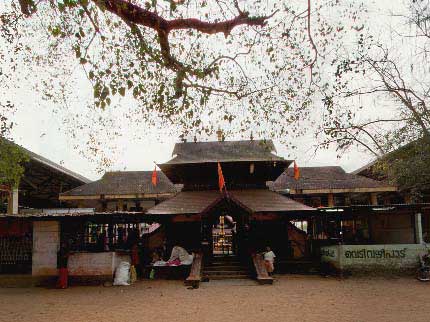
Showing posts with label Kerala temples. Show all posts

Thursday, 19 January 2012

Peruvanam Shiva Temple


Lord Shiva plays a significant role in Hindu Mythology and thus thousands of temples and shines had erected to show respect and esteem to him. Peruvanam Shiva Temple in Cherpu is prominent among them.  It’s a circular temple of Lord Shiva extended over an area of 6 acres. It’s an ideal example of Kerala style structural design and its architectural value dates back to the 12th century. The unique idol of Lord Shiva and two Shivalingom on the same pedestal is the prime resource of allurement of the temple. God Shiva is worshiped here, as Erattayappan.

Traditions

According to legends, of the 64 gramams which Parasurama created, Peruvanam remained the greatest for centuries. Four Shasthas - Akamala in North (beyond Wadakkancherry), Kutiran in East (midway between Thrissur and Palakkad), Edathuruthy in the West (2 kms east of Edamuttom Junction in Kodungallur-Thrprayar route) and Uzhathu Kavu in south (near Kodungallur) guarded the boundaries of its domain, roughly that part of central Kerala between Bharathapuzha in the north and Periyar in the south.
In a Brahmanippattu current in the locality, Peruvanathappan (Lord of Peruvanam) is described as the annihilator of the Thripuras. In a shloka attributed to Vilvamangalathu swamiyar, the pratishta is supposed to be of Ardhanareeswara.

"ardhanareeswaram devam
poorunancha pratishtitham
mateswaram mahadevam
parvatheencha ganeswaram"

Certain others claim that the two swayambhulingas reperesent Shankara and Narayana, a pointer to the amalgamation of Shaivism and Vaishnavism. Like in the Vadakkunnatha temple here also a certain order is followed in worshipping the deities (pradakshina krama), which is Erattayappan, Shri Parvathy, Dakshinamoorthy, Erattayappan, Maadathilappan, Pooru maharshi, Ganapathy and Erattayappan.
It is one of the imperative shrines run after the Cochin Devaswom Board. Vattezhuthu and Malayalam dedications have been imprinted on the walls of the temple and the temple is thus also known as Perumtrikkovil. 

Darshana Kramam

There are two approaches to the inner courtyard (Chuttampalam) of the Peruvanam temple, from the west and east sides. The main entrance is from the east. As you enter from the east you are facing Sreeparvathy, the Goddess who is the consort of Erattayappan. You may start the darshanam there, but have to come back later. There you are in front of a large circular sanctum sanctorum (Sreekovil) of Erattayappan facing west. It is the custom to start the worship with Erattayappan. Next, you go behind in an anticlockwise direction (Apradakshinam) and pray to Sreeparvathy facing east. There is a taboo all over Kerala in crossing the imaginary ray (Soma Rekha) emanating from Siva and going north. Hence, one does not make a complete perambulation in the inner courtyard of Siva temples. Most devotees at the Peruvanam temple go round the Bilva tree to the north and return clockwise to the south side where there is a shrine of Ganapathy and Dakshinamoorthy. You then, go back to the west and worship Erattayappan once again. There is an independent large, Sreekovil of another Siva, the Matatthilappan on the south. It is a three storeyed structure and you reach the shrine of Matatthilappan after ascending a flight of over twenty steps. You will find a huge Sivalinga at the back of a large Mukhamandapam (hall). It is believed that the Sivalingam worshipped by sage Puru for long years is beneath that. The sage, himself, has been enshrined to the south west corner of the inner courtyard (Chuttampalam). After getting down the stairs of Matatthilappan you pay obeisance to the sage. If you keep to the western border of the courtyard and walk to the north you reach the shrine of another Ganapathy, with his trunk twisted right. You pray to him for the ultimate goal in human life, for salvation and turn to the north side. There you get to the front of the last of the shrines inside the inner courtyard. Two deities are housed there, Raktheswary and Manikantha. The former is a form of Bhadrakali and the latter a form of Lord Siva. You must worship Erattayappan once again before coming out of the inner courtyard, through the same entrance you got in. There is a shrine, of Gosalakrishna, outside the main structure (Chuttampalam) of Erattayappan on the north side. This is Lord Krishna in the company of his dear cattle. You go in a clockwise fashion to worship Him. That ends the Darshana Kramam at the Peruvanam temple.

There is a verse (Sloka) describing this order of worship, as follows:

“Poorvan Pooruvane janais savinayam dwithwaasrayas sankaro
Vandyah, caatha gireendrajaa, punaratas sanyaasayogee kramaal
Yugmesasca, mahalayoparivasan maateswaro anantaram
Yogeendrasca, gajaananah, punarato yugmeswarasca kramaal.”

Meaning:

First, at Peruvanam, Siva in dual form is to be worshipped humbly by the devotees. Then, Sreeparvathy and then the Lord in meditation (to be worshipped). Then Ganapathy and then the Lord occupying a high abode (to be worshipped). Next the sage, Ganapathy and finally Irattayappan (are to be worshipped) We note here that the order of Ganapathy and Dakshinamoorthy is reversed and praying to Irattayappan after this is omitted. The omission of Raktheswary, Manikanthan and Gosalakrishnan must be as they have been enshrined in a later period.

Rituals and Festivals

Five poojas constitute the daily ritual in this mahakshetra. Special poojas such as Navakom, Niraputhari, Vishukkani, Pradosha pooja etc. were being conducted in the by-gone days. Vaaram (veda parayana) and Oottu (meals) were a regularily feature. The temple had lands yielding 4 lakh paras of paddy annually and a 29 day festival used to be celebrated with its culminating Arat in Arattupuzha - the mother of all poorams, with an array of about 108 caparisoned elephants carrying Bhagavathies and Shasthas of all the temples falling within the extensive Peruvanam gramom of yore. Ardra asterism in Dhanu and Shivarathri in Kumbham are the other important days in this temple. The tantries of the temple are Kunnathur Patinjaredathu Bhattathiri and Kizhakkedathu.

Om Namah Shivaya!


Taliparamba Rajarajeswara Temple


Lord Sree Rajarajeswara
Rajarajeswara(Rajarajeswara is one of the names of Shiva) Temple is situated at Taliparamba, 25 km away from Kannur. Taliparamba or Perinchalloor was one among the 64 brahminical settlement. The old name of Taliparamba was 'Lakshmipura' as this place was considered as an abode of prosperity. All the fame and prosperity to Perinchelloor Gramam is because of the presence of Sree Raja Rajeswara temple and the blessings of Perum Thrikkovilappan.Perinchelloor Gramam has been referred in the Tamil book "Pathittupathu",Chelloor Nadhodaym Chambu (Sanskrit), Kerala Pazhama, Kerala Mahatmyam,Jambukolpathi,Kokila Sandesam, Keralolpathi and many more. Between A.D.216 and 333 Perinchelloor was the capital of Perumakkans as referred in "Pathittupath".


Specialities


This temple has a prominent place amongst the numerous Shiva temples in South India. If any problem is encountered in temples of South India, the final solution is sought in this Temple through a prasna, a traditional method of astrological decision making. The prasna is conducted on a peedha (a raised platform) situated outside the temple. Taliparamba is one among 108 Shiva Temples in Kerala(ancient Kerala from Gokarnam to Kanyakumari) created by Lord Parasurama. Among these temples 12 are considered as most important and called Dwadasa Shivalayas(12 shiva temples). They are Gokarnam Mahabaleswara Temple(now in Karnataka), Taliparamba Rajarajeswara Temple, Kottiyoor Perumal Temple, Thrissur Vadakkunnatha Temple, Peruvanam Mahadeva Temple, Kodungalloor Thiruvanchikkulam Mahadeva Temple, Vaikom Mahadeva Temple, Ettumanoor Mahadeva Temple, Kaduthuruthy Mahadeva Temple, Chengannur Mahadeva Temple, Kandiyoor Mahadeva Temple and Suchindram Sthanumalaya Perumal Temple.


Taliparamba is regarded as one of the ancient Shakti Peethams. Legend has it that the head of Sati fell here after Shiva's tandavam following Sati's self-immolation. So this temple is popularly known as Rajarajeswari Temple. Siro Peetham or Sirassu is the other names given for Rajarajeswari Temple in some ancient documents. Interestingly Taliparamba Rajarajeswari Temple is also included in the list of 108 Durga Temples created by Lord Parasuram. In the list Taliparamba is mentioned as "Sirassilum".
Entrance wall of Rajarajeswara temple built in hard laterite

Architecture 
The quadrangular sanctum has a two tiered pyramidal roof. In front of the sanctum is the namaskara mandapam. The temple has no kodi maram (flagstaff) as opposed to other temples in Kerala. The balikkal has no roof but is embellished by a mysterious figure with a peculiar face. In front of the balikkal is a small rectangular building with a pyramidal roof, which is not usually found anywhere else. An inscription on the structure of the temple tank (which is a little away from the temple on the north side) indicates that the temple and the tank were renovated in 1524 A.D.


Sub Deities - Upadevathas

The Shiva linga here is believed to be thousands of years old. Legend has it that Shiva gave three sacred Sihvalingas to Parvathy for worship. Once sage Maandhatha propitiated Lord Shiva with intense prayers. Shiva was so pleased that he presented one of the Shivalingas to him with the injunction that it should be installed only at a place where there was no cremation ground. The sage, after searching all over, found Taliparamba the most sacred spot where he installed the linga.


After his death the linga however disappeared into the earth. Then his son Muchukunda offered similar prayers to Shiva and got a second linga, which too disappeared in course of time. Centuries passed. The third Shivalinga was handed down to Satasoman, a king of Mushaka (Kolathunad) dynasty who then ruled the region. He was an ardent devotee of Shiva. On the advice of sage Agastya he prayed to Lord Shiva who granted him the Shivalinga. Parasurama installed the Lingam in the present temple built by Satasoma.


Glory of Namaskaramandapa

The Namaskara Mandapa (mukha mandapa) infront of the Sreekovil(sanctum sanctorum) is the place where Lord Sree Rama (on his way back to Ayodhya from Lanka after defeating Ravana) prostrated before Raja Rajeswara. As a respect to Sree Rama no one is allowed into this namaskara mandapa and offer prayers, which is permitted in other temples for Brahmins.


Pooja Timing

The temple opens at 4.00 am in the morning and after Uchha pooja the temple will be closed at 12 am. The temple opens again at 5 pm. The Deepaaraadhana is performed at 6.30 pm and the last pooja, the Athazha pooja takes place at 8 pm.


While men are allowed to enter the Nalambalam always, woman are allowed only after the Athazha pooja in the night. At this time the Lord is supposed to be happy in the company of his consort, Parvathi, and pleased to grant the desires of His devotees whom pray to Him with humility and sincerity and this is considered to be the most auspicious time for women to enter the Naalambalam as they get the occasion to worship the divine couple.


Thanthri - Chief Priest

There are four Thanthris belonging to four Illams such as Poonthottathil Pudayoor Mana, Eruvesi Pudayoor Mana Edavalath Pudayoor Mana and Naduvath Pudayoor Mana. The present Thatris are Brahmasri P.P.Vasudevan Namboodiri, Brahmasri P.P.Pandurangan Namboodiri, Brahmasri E.P.Harijayandan Namboodiri, Brahmasri E.P.Kuberan Namboodiripad and Brahmasri N.P.Narayanan Namboodiri.


Traditional way of visiting the temple- Darsana Krama

According to the traditional system of visiting this temple the devotee first worship Lord Krishna at the shrine of Vasudevapuram located at the southern bank of the vast temple tank known as Aashraamath-chira, where there is a beautiful idol of Krishna playing the flute. Then, proceeding towards Sree Rajarajeswara temple one worship at the shrine of Sree Bhoothanatha (Kumbhodhara), who is the chief lieutenant of lord Shiva. The main entrance is on the east and before entering the nalambalam one turns eastwards and offers prayers to lord Vaidyanatha(kanhirangaatt-appan), an aspect of lord Shiva worshipped as the lord of physicians, enshrined in temple about 6 km from Rajarajeswara temple.

On entering the eastern gate the devotee makes a circumambulation of the whole central shrine before stepping inside the shrine. Towards the northern side there is a small shrine of a guardian deity called Yakshi. Usually a Yakshi is considered to be a female spirit with malevolent propensities, but the Yakshi installed here represents a prosperity-giving and benevolent spiritual power. The figure is a life size wooden sculpture of unique charm. The Yakshi is represented as one who is intently into a mirror.

After worshipping this guardian deity the devotee, proceeds towards the front of the central shrine and worships the Rishabha, the bull Ć¢€“ mount of lord Shiva out side the central shrine facing the lord. Near Rishabha is the Balikkallu of huge proportions, made of granite with many figurines and intricate carvings. Because of its great antiquity it calls for replacing it with a new one, maintaining its exact proportions and carving.

While circumambulating the Naalambalam (the outer structure around Sree Kovil, the sanctum sanctorum), one walk towards the left side and from the Nirarithikonam (south-west corner) worships Goddess Annapoorneshwari of the famous shrine in Cherukunnu, a few kilometer away, and standing on the west one worships Goddess Bhadrakaali enshrined in another renowned shrine of divine mother in Maadaayikkavu. Originally, it is said, that goddess Bhadrakaali was worshipped in the western Gopuram of Sri Rajarajeswara temple and later the idol was taken and installed in the shrine at Maadaayikkavu.

After making the circumambulation outside the Nalambalam the devotee enters the inner space around the sanctum sanctorum to worship lord RajarajeswaraĆ¢€™s Jyothirlingam. As usual in the temples of lord Shiva, the circumambulation is performed only up to the theertha-channel and it is completed with a reverse circumambulation up to the channel.

On the west of the sanctum sanctorum is the seat of divine mother Pravathi, the consort of lord Shiva. The door here is permanently closed. There is a symbolic legend regarding the permanent closure of this door. This legend is related to the active presence of both Shiva and Vishnu aspects of reality in this shrine.

Like many a temple legend this aspect is also symbolized by a very personalized legend relating to lord Shiva and lord Vishnu through an interesting story. According to it, once Goddess Mahalakshmi, consort of lord Vishnu, came to the shrine to pay obeisance to lord Rajarajeshwara. On seeing the arrival of Mahalakshmi, the lord decided that there should be her prosperity-bestowing presence also in the shrine. Therefore, the lord immediately assumed the form of Mahavishnu and goddess Mahalakshmi entered the sanctum sanctorum presuming that it was her lord and seated beside him. And only when lord Shiva assumed his original form did Mahalakshmi realize the mistake. After paying her respects to the lord, she was about to make a hurried exit through the back door when lord Shiva ordered his attendants, the Bhoothaganas, to permanentely close the door on western side at the seat of goddess Parvathi so that the aspect of material prosperity which goddess Mahalakshmi represented should also be vibrant in the shrine for the benefit of the worshippers.

Later, when lord Vishnu arrived at the temple in search of his consort, lord Shiva’s attendants prayed to him to allow the presence of goddess Lakshmi also in the temple for the benefit of the devotees, which lord Vishnu gladly conceded to before taking his consort along with him.

The legend thus signifies in a way interesting to the common people the special message that the spiritual presence in the shrine benefits the devotees for their material and spiritual well being. Signifying this combination of the Shaiva and Vaishnava aspects in the shrine, twice a year, during Shivaratri and Vishu, the Uthsavamoorthi of the nearby renowned Srikrishna temple of Trichambaram is ceremoniously brought to Sri Rajarajeshwara temple and both are worshipped on the same peetha. This is a unique custom in Taliparamba temple and thousands of devotees gather here on these days to have the darsan of Umamaheswara and Lakshminarayana. The Vishukkani darsanam in this temple is thus auspicious. This also signifies the fact that Shiva and Vishnu are the same. There is no Shaiva Vaishnava difference exists in Kerala.

The place Taliparamba is also known as Lakshmipuram and it is believed that the name is related to this legend. In some hymns to lord Rajarajeshwara the lord is also addressed as the Aishwarya prabhu, the lord of prosperity and Lakshmi Puraadheeshwaran the lord of Lakshmipuram.

Taliparamba Temple is also connected with two more temples - Thrichambaram Sree Krishna Temple andCherukunnu Annapoorneswari Temple. Taliparamba, Thrichambaram and Cherukunnu temples are collectively called Moonnambalams (three temples). Those who visit Taliparamba temple should also visit Thrichambaram and Cherukunnu temples. Visit to these three temples is called Moonnambalam Thozhal. Though it is not practised as widely as it was in the earlier days, it is still a religious custom among many local Hindu women to visit four prominent temples in Taliparamba when they are pregnant. For getting good children and for normal delivary pregnant women (before 5 months) usually visit these three temples along with Kanjirangad Sree Vaidyanatha Temple. It is believed that Shiva at Rajarajeshwara temple assures the child a high status, Sri Krishna of Trichambaram bestows with good nature and mental qualities, Goddess Annapoorneswari at Cherukunnam with wealth and the deity at Kanjiragat temple with long life. Now these four temples are well connected with roads. It is very easy now to visit these temples in a single day. Many pilgrims from different parts of the State visits these temples every day. These temples also attract devotees from neighbouring States especially from Karnataka.


Offerings - Vazhipadu

Ghee in small pots are offered to the presiding deity Shiva and are placed on steps leading to the sanctum. Its called Neyyamrithu in Malayalam language. The custom is that just as kings and emperors are seen only by offering some gifts-kazhchha-the Lord of Taliparamba, who is King of Kings, can be seen only by placing naiamrithu on the sopanam (steps leading to the sanctum). The ghee offered is used for abhisheka and for lighting the lamps in the central shrine. On auspicious days like Mondays, pradosham etc., hundreds of such small naiamrithu pots can be seen placed before the deity.


Festivals - Utsavams

Mahasivratri and Vishu are the two main annual festivals here. The 21 days annual festivals start in first week of March every year.


Rajarajeswara Stotras

The most distinguished of the royal poets of the Zamorin of Calicut, Uddanda Sastri, being a Nirgunopasaka was never given to worshipping of deities. Whenever he visited any temple he simply stood before the deity folding his hands. But when he stood before Rajarajeswara, the Kings, at Taliparamba he was so overwhelmed by the magnificence of the deity that he unconsciously uttered the words, 'Hara Hara Mahadeva', and prostrated himself before the Lord. Then and there he composed a verse to the effect that when he saw the splendorous crescent adorning the idol his hands automatically joined together in prayer. "Moon on your head is like an actual moon which makes the devotees fold their hand as if a water lilly does in the moonlight".


Kings and Rajarajeswara
In the past Kerala was divided into many small kingdoms and there were many kings/rulers. They all considered Lord Rajarajeswara as their Chakaravarthy (Rajarajeswara or King of Kings). The region was ruled by Zamorins(Samoothiri) of Kozhikkod and they were devotees of Lord Rajarajeswara. One of the Zamorins was an ardent devotee of the Lord of Taliparamba. After years of intense worship he is said to have entered the sanctum sanctorum and merged with the God. Even today when the elder Zamorin dies the information should be given to the temple authorities and the Lord is supposed to observe mourning. Even the distant Travancore kings paid obeisance to the deity by offering an elephant whenever a ruler is crowned or visited the temple.


J.Jayalalitha, the Chief Minister of Tamilnadu visited Sri Rajarajeshwara Temple at Taliparamba in 2001. Karnataka Chief Minister B.S. Yeddyurappa offered worship at Rajarajeswara Temple many times and in November 2008, he had offered an elephant. He worshipped Lord Rajarajeswara amid the political crisis faced by his government following the decision by 19 MLAs to withdraw support to the BJP government and he survived from the crisis. But even today none of the ministers of Kerala have the courage to enter before Lord Rajarajeswara.
The Taliparamba temple also was subject to attack by Tipu Sultan. One finds relics of the old gigantic gopuram at the entrance, which was demolished by Tipu's army. The story goes that when the temple was under siege, the head priest was inside the sanctum sanctorum and prayed ceaselessly day and night. it is further said that a black snake bit the commander of the army and a hooded serpent appeared before every soldier thus immobilizing the army and saving the temple from total destruction.


The place is considered as most sacred for performing Koodiyattam and Chakyar Koothu. Whenever a new Koodiyattam is being directed, first it is usually performed at this temple. However only the 'Maani' family of Chakyars solely posses the right of performing Koodiyattam here. Legendary Koodiyattam and Chakyar koothu maestro, Natyaachaarya Vidushakaratnam Padma Shri Maani Madhava Chakyaar had performed here for many decades. The title 'Vidushakaratnam' was awarded to him from this temple. One of the greatest appreciation or award that an artist/scholar can get, is the 'Veerashringhala'- Golden Bracelet, from the temple, given by the unanimous approval of the scholar body of the temple. Guru Mani Madhava Chakyaar is the youngest and last person to get the Veerashringhala from here.


How to Reach
Taliparamba is a Muncipality in Kannur district and is the headquarters of Taliparamba Taluk. Taliparamba is on the National Highway–17 and the Rajarajeswara temple is situated 23 Kms north-east of Kannur city. From Kasargod 83 Kms towards south. The devotees coming from Mangalore have to travel about 135 Kms south on Kasargode – Kannur route via Manjeswaram, Kanhangad, Nileswaram, Payyanur, Pilathara, Pariyaram to reach Thaliparamba. The nearest Railway stations are Kannur and Payyanur. Plenty of buses are running to Taliparamba from all the above places. 

 Om Namah Shivaya!


Malayalapuzha Bhagavathy Temple


Malayalapuzha Bhagawathi temple is just outside the Pathanamthitta town. The Goddess here is in the fierce form of the Goddess known as Bhadrakali. She is called Malayalapuzha Amma. The temple attracts devotees from all major religions of Kerala. The popular belief is that the Goddess is noted for getting the unmarried girls married, protecting the devotee from enemies, helping businesses flourish, getting employment and in general extending prosperity to all the devotees. 

There is a popular story about the temple. Long long time ago one Namboodiri Brahmin went by walk to the Mookambika temple at Kollur. He spent a lot of time there unable to be a part with the Goddess Mookambika. When he decided to go back to his native place near Maruthwa Mala, the Goddess appeared in his dream and told him that she will come along with him to his place and entered the Saligramam that he was worshipping. Since this happened at night she came in the form of Bhadra kali with eight arms and a very fierce looks. The Namboodiri reached along with a saligramam and a Palm leaf umbrella a palatial home called Thombil Kottaram. He stayed and took rest for few days. But when he wanted to take the Saligramam and Umbrella, they did not move from that place. That night in his dream, the Goddess came and told him that she likes the place and would like to stay there. She also told the Namboodiri, that he will not live very long and would merge with her soon. He died soon and due to that her worship was affected. Bad omens came in large number in that place and the Goddess entered in to a member of the Thombil family and asked them to build a temple for her at that spot. This temple was about 5 km from the present temple. That Goddess was consecrated facing east and nearby a Shiva Linga also has been consecrated. This was in a plateau which is in between five hills. Later according to the wish of the idapally king, the chief of Thombil clan shifted the Goddess to the present location. 
On one story is that the Chief of the clan became very old and was not able to climb the hills and reach the temple. He consecrated the Goddess in a spot on the shores of the south Malayala puzha, and below the Idathattil Mountain. It seems that there was a temple of serpents in that place and this was destroyed to accommodate the temple of the Goddess. Even today there is worship in the original temple and lots of devotees gather there on the first of every Malayalam month. 

There is another story about the origin of this temple. This temple was originally situated in a small village called Edathitta, in Pathanamthitta Dist. This was a full-fledged village ruled by Raja Shaktibhadran, the only Sanskrit south Indian writer. One day a tantrik from Malayalapuzha visited this place as he heard a lot about this temple. Malayalpuzha was in drought for many years. So the TANTRIK with his power migrated the shakti's of the devi to malayalapuzha. And the place progressed like anything. As the shakti's were taken away from edathitta, the place faced many destructions and gradually there were no signs of the temple. Then according to the prashnakundali people found out as in when it was migrated and when will it come back as the power cannot be transferred completely. It was mentioned that it will take 3000 yrs for this shakti to come back. And in 1992 somebody from that village saw a dream that the vigraham and the pooja utensils were beneath the ground and people started digging that place where they found everything mentioned by the person. And the villagers then contributed towards temple. 

The idol in the present location below the idathattil mountain is very fierce looking. It is made of concentrated Jaggery and is about 5 feet tall and has eight hands, with one leg moved to the front and kept on the Vetala and another stepped back. In spite of the fierce appearance the devotees only see mercy in her eyes. Since the idol is made of Jaggery, only flower worship is done to it. It seems there was a custom to remove the idol every twelve years and replace it with a new idol got made in Tamilnadu. But once the people were not able to remove the idol from its seat the Thombil Namboodiri that night saw a dream in which the Goddess told him that she does not want her idol to be removed and asked him to continue the worship for that idol forever. 
Just before entry to the sanctum, there is a small idol of Veera Bhadra and another peculiarity of the temple is the statue of Parvathi , on whose lap is the baby Ganapathi suckling her. For recovering stolen goods people offer Thoniyari Payasam (Payasam made of 36 ¼ para (Para is approximately 14 kg) of rice people believe that offer of Payasam made of with 101 Nazhi(120 ml) of rice, coconut milk, jaggery and 101 banana fruits offered to the goddess leads to fulfillment of our desires and success in business. Ladies offer Manjadi seeds (Adenanthera pavonina Linn) to the Goddess for increase of breast milk. This same seed after taking it round their hair is offered by ladies near the flag post for luxurious hair growth. Offer of arecanut, betel leaves, tobacco and camphor to the Goddess at the sanctum is believed to help us fulfill our desires. The sacred ash that you get back from the temple should be kept in the prayer room. People believe that within a year their desires would be fulfilled. People believe that when we make requests to the Goddess, if a honey bee from outside enters the Sanctum sanctorum and returns back in our presence then our desire would definitely be fulfilled. There is another peculiar belief in the temple that the soul of the devotees of the Goddess, after death comes and stays in the temple. So their sons/daughters come to the temple along with a piece of sandalwood packed in a red silk, make the soul enter that and take it out. This is called Chavirakkal (removal of death). Farmers pray that they will give a part of the harvest of their field and take a cloth from the temple, write on it that the produce belongs to the Goddess. People believe that if this is done then theft of the produce from their field is prevented. This is called “Malayalappuzha Thoopu”.

People also worship the Brahma Rakshas which is on the east of the temple for getting rid of ghosts, devils and evil magic affecting them. Offering of Mangalya to the Goddess to get married quickly is also done. Just outside the temple The Naga Raja also is consecrated. Near it we can see a Konna tree which flowers daily all the yearlong. Below that a Shiva Linga which is a Swayambu can be found. People believe that this Shiva linga keeps on growing. People believe that if this Shiva linga is bathed with tender coconut water immediate rain will result. 


There is a temple (half a km away) for the Yogeeswara grand father who brought the Goddess to this place. This is called Sri Kandeswari Moorthi Kavu. There are also Pancha moorthi idols in this temple. Here toddy, meat, Agar Bhathi, tobacco etc are offered to the grand father statute. People believe that the Goddess would be happy only if we visit this temple first before visiting her.

Unlike other Bhagwathi temples , there is no practice (asked to be discontinued by the Goddess ) of drawing her figure using rice powder, turmeric, saffron etc but the usual singing of her story is done there without it. Another peculiar custom of the temple is that the procession carrying the deity turns left (ie clockwise) and because of this people called this Goddess Idathattil Bhagwathi( Bhagawathi of the left).

 Amme Narayana

Peralasseri Subrahmanya Temple


Lord Subrahmanya, son of Lord Siva, is the presiding deity of this temple. The temple is said to be connected with the famous epic, 'Ramayana'. It is believed that it was here that Lord Rama along with Lakshmana halted on their way to free Sita from Ravana in Lanka. The temple also has a shrine for the serpent God and has a number of bronze and copper idols of snakes. The annual festival of the temple is celebrated for eight days. Kathakali, Chakyarkoothu, Ottanthullal, Parayan Thullal and Seethankan Thullal are the main art-forms performed during the festival. Another important concert during the festival is a highly religious dance, ' Thidampunritham' performed by the priest. Peralaserry Subramania Temple along with Payyanur Subramania temple is probably the most important and must visit Subramania Temples in Kerala. 
The Peralassery Subramanya Temple, is located 15 kms from Kannur. It is also believed that people who visit Peralaserry temple must also visit the nearby Makrery temple. The main “vazhipaddu” or offerings in this temple are “Subramania Puja” and “Mutta Oppikal” (offering of eggs to the revered snake deity). The main deity of this temple is Lord Subramania. “Chuttambalam” has deities of Lord Ganesha, Lord Ayyapa. The Stepped Pool/Tank or “Chira” of  the Peralassery Subramania temple is a magnificent structure. The week long Kodiyettam festival associated with the Peralassery Subramanya temple is in the Month of December, every year. 

How to get to Peralaserry Subramania Temple, Kannur, Kerala.

Nearest Railway Station : Kannur (Cannanore) 16 Kms away. 
Nearest Airports: Mangalore in Karnataka State, about 50 kms from Kasaragod and  Kozhikode (Calicut) International Airport , Karipur, about 200 kms from Kasaragod
Main Private Bus Terminal in Kannur: 16kms away. 
KSRTC Bus Terminal in Kannur (Caltex): 15Kms away. 


Om Sree Subhramanya Namah!

Thursday, 18 November 2010

Attukal Bhagavathy Temple

Attukal Bhagavathy temple
Attukal Bhagavathy Temple - The Unique abode of the Divine Mother


The story goes that the Goddess Bhagavathy revealed herself to a fervent devotee of a 

notable family viz. Mulluveettil family. It is said that one evening a young girl appeared before the head of the family while he was performing his oblations in the Killi river and requested him to help her cross the river. Impressed by her charismatic demeanor, the- old man bent before her with awe and reverence and not only helped her cross the river but took her to his house nearby. Strangely enough, while the household members were amidst preparations for intending a warm welcome to the young girl, she vanished. That very night the Goddess Bhagavathy appeared as an icon before the old man in his dream and demanded that he should establish an abode for her in the nearby sacred ground of shrubs and herbs (kavu), at a consecrated spot marked by three lines. The next morning the old man went to the spot revealed to him in the dream and to his great surprise he did find three marks indented on the ground. He lost no time in erecting a temple on this consecrated spot to house the Goddess. Many years later, the building was renovated by the local devotees. They also installed a beautiful and majestic icon of the Deity with four arms, bearing weapons of destruction in each, like spear, sword, skull, shield etc. The consecration ceremony of this Exalted Being was performed by no less a person than the high priest of the Badarinath Temple.


The Attukal Bhagavathy Temple, one of the ancient temples of South India, is popularly described as Sabarimala of the Women, as women form the major portion of devotees. The Goddess in the temple of Attukal is worshipped as the Supreme Mother, creator of all living beings and the mighty preserver as well as destroyer of them all. The pilgrims from all over the country, who visit Sree Padmanabha Swamy Temple and worship the Lord, do not consider their visits complete without the visit to the shrine of the supreme Mother Attukalamma. Vishnumaya took the incarnation of Bhagavathy to annihilate the evil and protect the good in the world in the present Era namely Kaliyuga.


According to mythology, Attukal Bhagavathy is supposed to be the divinised form of Kannaki, the famous heroine of Chilapathikaram, written by Elenkovadikal, the Tamil Poet. The story goes that after the destruction of ancient city of Madurai, Kannaki left the city and reached Kerala via Kanyakumari and on the way to Kodungalloor took a sojourn at Attukal. Kannaki is supposed to be the incarnation of Parvathy, the consort of Paramasiva. The all powerful and benign Attukal Bhagavathy reigns eternally supreme at Attukal and nurses devotees as a mother does her children. Thousands of devotees from far and near flock to the Temple to bend before the Goddess with awe and reverence to prostrate and redress their affliction and agony.
The Pongala Mahotsavam is the most important festival of Attukal Bhagavathy Temple. The offering of Pongala is a special temple practice prevalent in the southern part of Kerala and some parts of Tamilnadu. It is a ten-day programme commencing on the Karthika star of the Malayalam month of Makaram-Kumbham (February-March) and closing with the sacrificial offering known as Kuruthitharpanam at night. On the ninth day of the festival the world famous Attukal Pongala Mahotsavam takes place. The entire area of about 5 kilometre radius around temple with premises of houses of people of all caste, creed and religion, open fields, roads, commercial institutions, premises of Government offices etc. emerges as a consecrated ground for observing Pongala rituals for lakhs of women devotees assembling from different parts of Kerala and outside. The ceremony is exclusively confined to women folk and the enormous crowd, which gathers in Thiruvananthapuram on this auspicious day is reminiscent of the Kumbhamela Festival of North India.

                                   
Incarnation of Goddess
India has ever been the holy land of gods and goddesses. Since ages past, men and women kings and emperors, saints and sages here were worshipping the Lord not only as the omnipotent and absolute 'one' but also as the 'one' whose manifestations are varied and manifold and who possesses different names, forms and divine attributes. Thus Almighty the Eternal God was worshipped in different forms such as Brahma, Vishnu and Siva, and their consorts; representing specific divine attributes of the Lord. Ancient puranas have described that Siva and Sakthi were simultaneously worshipped from the period of Aryans and Dravidians. Vishnumaya took the incarnation of Bhagavathy to annihilate evil and protect the good in this world. She grants every wish of Her devotees and resides in their hearts in multifarious forms.


Story of Kannaki
According to mythology, Attukal Bhagavathy is supposed to be the divinised form of "Kannaki", the famous heroine of Chilappatikaram, the sangham work of Tamil Literature written by ilamkovadikal. After the destruction of the ancient city of Madurai, Kannaki left that city and reached Kerala via Kanyakumari and on her way to Kodungalloor took a sojourn at Attukal. The hymns of the "Thottampattu ) sung during the annual temple festival, are based on the story of Kannaki. Moreover, architectural depictions of Goddess Kannaki seen on the Gopuram temple substantiate this mythology. Small wonder then. that, Sri. Vidyadhiraja Chattambi Swamy, the well known saint of Kerala, found this temple premises ideal for his meditations. And there are so many stories which prove the greatness of the Goddess and which attract thousands of devotees to the temple.

Aesthetics of Architecture
Anyone visiting the Attukal temple is first struck by the beauty and charm of the temple architecture. The temple structure is a harmonious conglomeration of both Kerala and Tamil styles of architecture. The beautifully carved figures of Mahishasuramarddini, Goddess Kali, Rajarajeswari, Sree Parvathy with Lord Paramasiva and various other depictions of the Goddess in and around the temple are undoubtedly the work of a gifted artist. Equally well presented around the corridors surrounding the temple, are the depiction of various other Gods and the epic stories of the ten incarnations of Lord Vishnu viz., the "Desavathara". On either side of the elegant front gopura - are the icons based on the story of Goddess Kannaki. On the southern Gopura, the puranic story of "Dakshayaga" is depicted in sculptures. The decorated gate at the entrance of the temple is by itself an excellent example of architectural beauty.

There are two idols of the Goddess in the sanctum sanctorum. The original idol is preserved in all its pristine beauty covered in ornamental gold embedded with installed stones. The second idol of the Goddess is installed besides the original one. Within the temple corridors are also installed carvings and sculptures of Lord Ganesan, the serpent God and Lord Shiva. At the centre of the Sanctum within the Sreekovil, at a consecrated spot is installed the idol of the Goddess Attukal Bhagavathy emanating light and lustre to all.

"Sarva Mangala Mangalie Sive Sarvardha Sadhike 

Saraneye Thrambike Gowri Narayani Nomo sthuthe" 

Wednesday, 17 November 2010

Chottanikkara Bhagavathy temple

Chottanikkara Temple
This is the most famous temple of Kerala where mentally disturbed people, come in thousands and get cured. This temple is 8 KM away from Thripoonithura a suburb of Cochin.


There are two main temples here. One as soon as we enter is the temple of Rajarajeswari and the one behind it in a slightly lower elevation called Keezhekavu has Bhadra Kali consecrated there. The Rajarajeswari is worshipped as Goddess Saraswathi in the morning, worshipped as Bhadra kali in the noon and Durga in the night. This temple opens every day at 4 AM. People believe that Goddess Mookambika of Kollur attends the first worship here before going to her temple. Another peculiarity of this temple is that the Goddess is not fixed to the ground but rests on sand. Nearby her is the statue of Lord Vishnu. So the devotees always pray her together with her brother Lord Narayana and say Amme Narayana.

It seems once the place this temple is located was a dense forest. There lived a tribal man called Kannappan, whose wife had died. Kannappan was a great devotee of Goddess Parvathy. He used to daily sacrifice an animal to his favourite Goddess. He had a cute daughter who was very fond of her pet, which was a cow. Since her father used to sacrifice cows, she kept her pet cow very near her and looked her after well. One day Kannappan could not get any animal to sacrifice to her Goddess. So he ordered his daughter to give her pet cow , for that days sacrifice. His daughter requested Kannappan to sacrifice her instead. The heart of Kannappan changed and he realized that he was doing a wrong thing by practicing animal sacrifice. He and the pet cow stayed near the temples Bali stone the entire night. In the morning, the cow herself had turned in to a stone. That place is called Pavazha malli thara (Place of the coral jasmine flower). People believe that pet cow of daughter of Kannappan was indeed Goddess Mahalakshmi. That day Lord Vishnu appeared before Kannappan and pardoned his sins and decided to be present in the temple along with the Goddess. That is how the concept of Lakshmi Narayana came in to this temple. The place where Kannappan used to sacrifice his cows is the location of the Keezhe kavil Bhagawathi.

It seems this temple location was rediscovered accidentally by a low caste grass cutter, who found that blood was flowing out of a stone which she accidentally cut. That day the Brahmin of the Yedattu house came along with the puffed rice in a coconut shell and this was offered to the Goddess for the first time. Even today this system of offering puffed rice in a coconut shell continues. The Brahmins of Yedattu house became priests at this temple. It was Adhi Shankara who visited the temple , who brought in to the Statue the presence of Mookambika. It seems when Vilwamangalam Swamiyar visited this temple he saw a powerful halo of light over the temple pond. He instituted a search and the present statue of Keezhe kavu was found in the tank. There is also a story of certain Gupthan Namboodiri who was pursued by a Yakshi. It seems the Yakshi took a form of a pretty maiden and tried to entice the Namboodiri. Since Namboodiri was carrying a Devi Mahatmyam book, she was not able to do anything. But being attracted by her Gupthan Namboodiri wanted to leave the book, with his magician friend Kosapilli Namboodiri. The magician found out that the lady was a Yakshi. He gave Gupthan Namboodiri an enchanted towel. With the enchanted towel Gupthan ran up to the Chottanikkara temple. There he threw the towel outside and jumped in to the temple. The Yakshi who was pursuing him could catch hold of his feet. When Gupthan cried for help from the mother, she came out and cut the Yakshi in to pieces and threw her in to the temple tank. That tank is known today as Yakshikkulam or Rakthakulam. It is to Keezhe Kavu Bhagawathi that the mentally disturbed people turn to for a cure. They are brought tied to the temple. As soon as they see the goddess, especially during the Guruthi (anointing with red saffron liquid), they start jumping uncontrollably. At night after 8.30 Pm, there is a valiya Guruthi in which Guruthi from 12 huge vessels is poured over the Goddess. It seems if the mentally disturbed people see this Guruthi daily, the spirit which is affecting them will run away. There is also a pala tree, in which these people drive huge nails by knocking the nails with their foreheads. People who are having a weak mind and are easily scared are requested not to go to the Keezhekkavu temple. There are also temples of Lord Shiva, Ganapathi and Nagar in this temple.


The major festival of this temple is in the month of Kumbam (February –march). The goddess comes out of the temple blesses all and after ritual bath (aarattu) goes back to the temple.
In the same month on the Makha star day between 2 :Pm to 5 Pm, there is a observance of Makham thozhal People believe that if unmarried people do that , they will get married and if married people do that the understanding between husband and wife would increase. 

Other Important Months:
§  Chingam - Thiruvonam is celebrated in the temple with Thiruvonam feast (annadanam) to all Pilgrims
§  Kanni - Navarathri aghosham is a famous festival,which attracts large number of devotees. On Vijayadasami day of the Navarathri ulsavam, Vidyarambham is conducted.
§  Vrishchikam - The Vrishchicka Mandala mahotsavam (festival) is celebrated during the entire period of mandalam season.Daily annadanam, stage programmes, Naama japam etc. are conducted. During this month,Thrikkarthika festival comes. It is the birthday of the Goddess and the festival runs for three days, Kaarthika, Rohini and Makayiram. On these days,there is ezhunnellippu, Kazhcha siveli, stage programme, deepaalankaaram, Kaarthika vilakku, fireworks etc.There is also lakshaarchana and Vedamura abishekam for 15 days starting from January 1. On the makaravilakku day there is lakshadeepam (lighting of one lakh lamps) and fire works.
§  Medam - On the Vishu day, there will be Vishukani, Vishusadya and ezhunellippu on 3 elephants.
§  Karkitakam - Ramayana masam (Ramayana Month) is celebrated during this period. Daily puranam reading (Ramayanam, Bhagavatham, etc.,) daily annadanam, devotional speeches and discourse etc., is conducted - there is also illam Nira, when fresh paddy of the year is offered to God.
Amme Narayana

Tuesday, 16 November 2010

Uthralikavu – A Durga Devi temple

Uthralikkavu
Uthralikkavu – A Durga Devi temple in Central Kerala 

Uthralikkavu, or Rudra Maha Kali Kavu, situated in the halcyon pastures of Akamala Desham (aka 'inside'; mala ‘woods’, in other words, a valley), in Thalappilli Taluk, Enkakkad Village, Wadakancheri Panchayat, Trichur District, Kerala, is famous for its annual pooram/vela festival. Uthralikavu Pooram is one of the spectacular temple festivals to be witnessed in Central Kerala during Summer (Feb-March). It is a festival filled with thrills and excitements with the procession and marching past of a number of elephants with colourful decoration to the accompaniment of the resounding Panchavadyam and the Pandimelam - two types of drum orchestration quite loved by the locals and tourists alike - and the fireworks that follow after the panchavadyam and chendamelam is one, it can be said, with no parallels to be found anywhere, even in Trichur Pooram that is wellknown all over the world.


Regarding the history of Uthralikavu, there is a story told by the elders about this temple in Enkakad. They say, the name Enkakad is derived from the word Thinkalkadu meaning The hair of Shiva(thirujada) in which moon resides. Lord Siva begged rice from the hill nearby called Uriyarikunnu (Uriyari—About 150 ml of rice) and with the rice so received, he prepared his dinner at a nearby place. This place was called Vechanad in Malayalam, which later became Machad. Lord Siva found this place so beautiful that he gave seats here to the two goddesses (Bhagavathies), one at the north east i.e., Akamala for Rudrakali (Rudhiramahakali or Uthrali as known now) and the other at south i.e., near Vazhani for Thiruvaani (Vaani means voice, speech, music etc.). It is also believed by the local people that Thiruvaanikavu Bhagavathy is elder sister of Uthralikkavilamma. Accordingly, Thiruvanikkavu Vela / Pooram (better known as Machad Mamankam or Kuthiravela) takes place one week prior to Uthralikavu Vela / Pooram. 


There is also another belief that Uthrali Bhagavathi who is another form of Mookambika Devi, is the sister of Mahakurumba Bhagavathi, who is one of the deities installed in the Shiva temple in Karumarakkad, Wadakancheri, 3 Kms. away to the south from Uthralikavu. So, on the day of Pooram, Karumarakkad Bhagavathi comes to Uthralikvau on elephant back to see her sister. Poorams at both these locations, Karumarakkad and Uthralikavu, with caparisoned elephants, start simultaneously and then from Wadkancheri the decorated elephants in procession come to Uthralikavu with the ‘akambadi’ (protection) of a team of policemen and a large number of devotees. They converge in Uthralikavu where both the Bhagavathies meet and stand in line and a *Kootti Ezhunnallathu takes place.


However, there are variations in the story. As legend goes, Kelathachan was a local chieften in Talappilli Taluk of Trichur District, like the Paliathachan of Trichur. Kelathachan had his mansion in the bosom of Akamala, an evergreen forest famous for its flora and fauna. The green stretches of paddy fields owned by him on the western valley of these forests were rich in yields. 


During his tours Kelathachan used to keep a palm-leafed umbrella (Olakuda). It was believed that Goddess Mookambika, when once Achan visited Kollur, came alongwith him sitting on top of his umbrella. When he kept his umbrella on the ridges of the paddy field owned by him near his Farm House in Mullakkal, Akamala, on the east side of the railway line, bhagavathy got out of the umbrella and sat on the ridges. This place is known as the Mullakkal Sreemoolasthanam of Uthrali. An ‘Aal’ tree was planted behind this place, to protect Devi from sun and rain.

After a long time, once a harijan lady had a strange experience a little away from this location on the other side (west) of the railway line. While sharpening her sickle on a stone, under a ‘Poovam’ tree, she saw blood dripping from the stone and was frightened and therefore screamed aloud. Male workers who heard the sound, came to the scene to witness the strange incident. They reported the matter to Kelathachan. As was the practice, he consulted the Astrologer. According to the astrologer, bhagavathy liked to have a permanent abode there under the tree to bless her devotees. In the ‘Prasnam’ i.e. indications appearing to the astrologer, this goddess was found to be ‘Vana Durga’, who liked to be under the tree, and so an open roofed temple protecting the Poovam tree was built there and Bhagavathy was consecrated in it and worshipped with all relevant rituals. Even now the sanctum sanctorum of this temple is under a Poovam tree, which is replanted after the earlier tree perished over time.

It was also seen in the Prasnam that this Devi liked a poojari belonging to tamil Brahmin community only rather than the usual Namboodri community who used to be ruling in most of the temples in Kerala. A Tamil Brahmin was, therefore, located in a nearby village called Padinjattimuri village (near Wadakancheri) and he was appointed there as the Chief Priest. He belonged to Chakkingal Madam and to this date for generations from Tippu Sultan’s time, the priest here is from Chakkingal Madam only. 

In fact, this tamil Brahmin family originated from a Brahmin lady who had run away from Palghat (previously of Madras State) hearing that Tippu Sultan was going to conquer Palghat very soon. She wanted to escape from the Muslim Ruler and came over to central Kerala. She came to a place called Vlaha near Triprayar Srirama temple and took abhayam/asylum in a Namboodri’s Illam. She had her small child and an ‘Uruli’ (a vessel of a particular alloy which is used for making Payasam especially in temples) with her when came over to Vlaha. The boy was, later on, known as Vlahayil Annayan Pattar and the Uruli his mother (the Paatti who came to Vlaha) had carried along with him was available, fully worn out, even till recently with the descendents of the family as a piece of evidence of their ancestral history traced from the time of Tippu Sulatan’s padayottam. 

Annayan Pattar was a very good cook (cooking was his profession – As TN Sheshan very aptly told, only three categories were there among tamil Brahmins settled in Kerala and they were, cooks, crooks and civil servants! The three Cees. - His progenies, Chakkingalmadam descendents, became very famous people such as Judges, Lawyers, CEOs, Collectors, Musicians, Doctors, Priests, Landlords, and whatnot. They all owe their progress to the devotion and dedication with which they worshipped Uthrali Bhagavathi. 

Chakkingalmadam Krishna Iyer, - CK Krishna Iyer – a descendent of this family, fondly called by everyone as Ambi Swamy, and father of the existing chief priest of Uthralikavu, Sri CK Rama Iyer alias Ramu Swamy was the Chief Priest here for more than six decades, from 1918 to 1981, and during his time the temple developed from stage to stage from frame to fame. He used to devote his entire time for Devi upasana and dedicated his life for the service of the devotees coming to this temple. He was a vedic scholar by profession who had his ‘Adhyayanam’ (Gurukula learning) at the Sanskrit Veda Patashala at Thiruvidaimarathur for over seven years.


Figure 1 A 1970 file photo of the Chief Priest, Sri Ambi Swami and wife. The temple administration and other routine maintenance, etc. was previously in the hands of the people belonging to the three villages – Enkakkad village (in which the temple is situated), Kumaranellur and Wadakancheri villages, the two neighbouring villages adjoining. They conducted the annual temple festival (Vela) in a small scale by collecting subscriptions from the villagers then and now they conduct it in a grand scale by collecting money from devotees all over the world. However, the administration was eventually passed on to the Cochin Devaswam Board and this temple is under this Devaswam who takes all the income from this temple and also make monthly payments to the employees of this temple such as melsanthi, keezhsanthi, variar, marar, masappadi, velichappad, etc. who eke out a living by serving the temple.

Uthralikavu pooram - In olden days it was Uthralikavu Vela. Now it is called pooram. The change from vela to pooram – bigger form - was gradual. Seven days in advance of the Pooram day, the flag hoisting ceremony (kodiyettam) takes place. Bhagavathy comes out of the kavu (temple) and goes around the nearby villages to bless her devotees at their residence and to accept their offerings, in the form of Nirapara (Para is an old measurement of grains in Kerala). The materials offered should have minimum one Para of paddy, supported by flowers, raw rice, fried paddy, jaggery, turmeric, fruits etc. The Komaram/Velichapad who visits the homes (Velichapadu being the representative of Bhagavathy) gives oracles, in a faith-evoking atmosphere created by Chenda (trumpet), Ilathalam (cymbals) and Kombu (musical horn). The first Para in this weeklong tour of Bhagavathy is expected to be given by a member of the family of Kelathachan at his Mullakkal Tharavadu. Both the temple (Uthralikavu as it is called by the public) and the Sreemoolasthanam (Akamala Mullakkal Alinchuvadu) are situated in Enkakad Village. Therefore, the villagers of Enkakad have the privilege of beginning the pooram, on the pooram day. This will be followed by Kumaranellur while the pooram procession from Wadakancheri will reach the temple premises when the pooram by Kumaranellur is half way through. Later all the three parties will join together and line up the decorated elephants at the main pooram venue in front of the temple after the fireworks are over. This is called *Kootti Ezhunnallethu in Malayalam (means joint procession) which will be a wonderful scene to enjoy with all the elephants with glittering and colourful decorations alongwith Pandi Melam (orchestrated drum beating).

Uthralikavu Pooram / Vela is also a festival of Villagers, after the harvesting season presenting various rural art forms like pootham, thira, nayadi, kummatti, kalakali etc.  Uthralikavu pooram is conducted with the active participation of the three villagers in Wadakanchery Panchayat, viz. Enkakad, Kumaranellur, Wadakanchery, who mobilize resources from all over, and make the Pooram more and more grand year after year. They vie with each other in presenting leading elephants, percussionists and pyrotechniques. 


Figure 2 A scene from Uthralikavu Pooram.


How to reach the temple and where to stay.
10 degrees, 40 minutes, 21 seconds North, and 76 degrees, 15 minutes, 47 seconds East


Uthralikavu temple is well connected by State Highway (Trichur-Shornur State High Way-22); it is at the very brinks of the Highway in a valley which is full of greenery and food-crops. In fact, Uthrali Bhagavathi is Annapoorneswari Herself as is evident from the richness of the area and ambience of the temple where She resides. The Trivandrum-Shoranur-Chennai railline is running next to the boundary of the temple and a rail traveler in this route can see this temple from the train and enjoy the scenery. 


One can reach the temple by any mode of road transport running between Trichur and Shoranur or between Trichur and Chelakara. The nearest town is Wadakancheri which has got a Railway Station (barely 4 Kms. from the temple) where most of the trains do halt. However, Trichur is the major railhead south of Uthralikavu where all the long-distance and other high speed trains, like Rajadhani Express, will stop. Trichur is only around 20 Kms. from the temple. Similarly Shoranur Junction is another major railhead north of Uthralikavu where people from North Kerala, such as Pattambi, Calicut, Kannur, Kasargod, and also from Mangalore can disembark and come to the temple travelling a small distance of 10 Kms by road which is well connected by buses and taxies.
The nearest airport is Nedumbansseri, near Cochin and the distance is about 50 Kms. from there to the temple which can be travelled by rail upto Wadakancheri and from there by road 4 Kms, or the entire distance by road / by bus or taxi. Calicut and Coimbatore are the other two airports nearest to this location from where plenty of surface transport (rail and road) is available to reach the temple. The approximate time to reach the temple from these two airports either entirely by road/taxi/bus, or rail and road will be around 4-5 hours only including the time taken to travel from the airport to the departure railhead and from the arrival railhead to the temple by road.
One can stay put in Wadakancheri town with a moderate budget in small hotels, but if one is particular about staying in high class accommodation/some star hotels, one has to seek such accommodation in Trichur town only which is the nearest major town in the mainline at a distance of 20 Kms. from the temple. Besides, Trichur does have three famous temples viz., Vadakkumnathan Shiva temple, Parmelkavu Bhagavathi temple and Thiruvambadi Krishna temple. Apart from these, the famous Guruvayoor temple is only at 40 minutes’ travel by train from Trichur.


The temple can also be located/viewed by Google search at geographical coordinates: 10 degrees, 40 minutes, 21 seconds North, and 76 degrees, 15 minutes, 47 seconds East. [ 10°40'21"N 76°15'47"E ]


Other festivals in the temple

Uthralikavu temple was re-constructed a few years ago with more beautification plans and the picture given on top of this description is the current view of the temple from the State Highway. As a result of the re-construction ‘Kalasam’ was done (it is a ceremony performed for the purification of the temple and its premises) and the day on which the Kalasam was performed is called ‘Prathista Dinam’ and it is celebrated every year with pomp and pageant. Although this concept of celebrating an ‘installation day’ or Prathista Dinam as is known in Malayalam, is contrary to what was stated above in the history of the origin of this temple, (i.e., that the Bhagavathi here is not an ‘installed’ deity, that it originated itself as Swayamboo) under a Poovam tree, for the sake of commemorating the reconstruction of the temple, this annual festival is conducted. During the re-construction, however, care was taken to preserve the Poovam tree as it is and the Sreekovil (sanctum sanctorum) was done up only without disturbing the tree and the open sky nature of the same. On the day of Prathista Dinam which is conducted on the Avittam Nakshatram/star during the Malayalam month of Medam (April-May), there will be Sheeveli (Elephant ride) of Bhagavathi with three elephants for about two hours in the morning from 10 AM and also two hours in the evening from 4 PM. A smallscale fireworks will also follow this. In other words one can witness a Mini Pooram here on this day. There will be Annadanam for all the devotees visiting this temple on that day.

Another notable event in the temple calendar is Mandalam which is a period of 41 days during which special puja is performed beginning from the Malayalam Month Vrischikam upto 10th of Dhanu (November-December). The temple premises will be decorated during these days and special pujas will be offered. It is said that during these days, the goddess will come out of Sreekovil and remain in the special Mantapam decorated for this purpose. It is during this season generally Ayyappa devotees start penance and visit Ayyappa temple at Sabari Mala. So one can see many Ayyappas visiting this temple during this time, taking bath in the temple pond and calling Saranam. 

Temple timings and main vazhivads/offerings

The temple is thrown open early in the morning by 4-30 and it is closed by 10-30 every day except on Fridays, Tuesdays and Sundays when the closing will be done only at 11 AM. Similarly, in the evenings, the temple opens at 5 PM and remains for darshan till 8 PM on all days. On the Pooram day, however, the temple will be open throughout day and night. 
The main vazhivads/offerings in the temple are: Niramala, Chuttuvilakku, Nei Payasam, Kadana Vedi, Nei Vilakku, Pushpanjali/Archana, Mala and Bhagavathi Seva. Apart from these, there are offerings such as Chatussatayam, Thrikala Puja i.e., Udayasthamana puja, and such other normal vazhivadus found elsewhere.
To perform special pujas such as Chuttuvilaku, Niramala, Udayasthamana puja, etc., one has to book in advance and for all offerings, one has to take receipt from the Devaswam Board employees posted in the temple. The items of offerings and their rates are displayed in a board kept near the cash counter in the temple. 
Uthrali Bhagavathi Sahayam