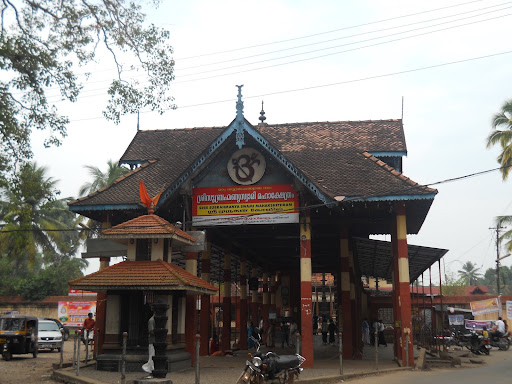
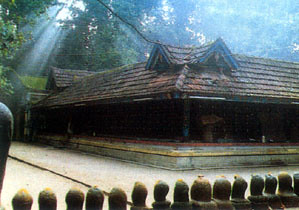
Guruvayoor Temple is famous as *Bhooloka Vaikuntam* (Vaikuntam on earth).
*Srimad Narayaneeyam* (which has the stamp of approval by Bhagavan Krishna Himself) begins with the statement : “ It is the greatest fortune of mankind in this *Kali Yuga* that the *ParaBrahman* manifests itself as Bhagavan Krishna Deity in Guruvayoor temple to bless the Bhaktas . He is incomparable, eternal, free of Maya (illusion), all-pervading and the root cause of entire Universe. Even the Vedas cannot fully understand Him. But, just by Krishna-bhakti alone, devotees easily attain Guruvayoor Bhagavan. Although such a very easy Krishna-realization is readily available at Guruvayoor temple, foolish people fail to worship Him. But, we Krishna-Bhaktas, with a firm mind take refuge in Guruvayoor-Bhagavan ,the very embodiment of *ParaBrahman*. ”
Yes! Mankind is fortunate indeed for having been blessed with Guruvayoor Temple. Shree Guruvayoorappan is ever willing to grant the glorious vision of his charming form and shower his blessings on the Bhaktas who come to Guruvayoor temple. Many Bhaktas are thanking Him for favours already granted, and some praying for desires to be fulfilled, and some just to offer their humble prostrations. Guruvayoorappan has been presented to the devotees, as decreed by Bhagavan Himself for the benefit of mankind in the Kali-yuga. Is not the mankind fortunate ?
Many Mahatmas like Sankaracharya and Vilwamangalam had the divine vision of Bhagavan Shree Krishna in Guruvayoor temple . Guruvayoorappan is *Pratyaksa-deva* ( visible God) to the living legend Bhagavata-hamsam Malliyoor Sankararan Namboodiri. Guruvayoor temple’s unique *Acharams* ( traditions) including daily rituals and Poojas were formulated by Adi Sankaracharya under Bhagavan’s guidance. These *Kshetra-Acharams* are being strictly followed without any compromise. The Temple Tantris are available full time at the Temple to ensure this. The *Melsanti* ( Chief Priest) enters the *Sri Kovil* (( sanctum sanctorum)) at 2:30 AM and he does not drink even a glass of water up to the completion of noon poojas at 12:30 PM. This absolute purity of vedic tradition is the hallmark of Guruvayoor temple .
EARLY HISTORY
The *Narada Purana* in its chapter *Gurupavanapura Mahatmya* states: "King Janamejaya, in order to avenge the death of his father Pareekshit, (who was killed by Serpent Chief Takshaka ), performed the *Sarpayajna* (snake sacrifice) in which thousands of innocent serpents were burnt alive . As a result of their curse, Janamejaya was afflicted with terrible leprosy, which left him in utter despair. Sensing this, Sage Dattatreya appeared before him with a remedy – Seek the mercy of Bhagavan Krishna, at Guruvayoor temple ”.
The Sage recounted that, Bhagavan Maha Vishu Himself was the first to worship this *Moorty*. At the beginning of the Padma Kalpa, he gave the image to Brahma. At the beginning of the *Varaha Kalpa*, the childless couple, Sutepa & Prisna prayed to Brahma for a son. Brahma gave them this Moorty, assuring them of their wish if they worshipped the Moorty with sincere devotion. This they did with excellence, so much so that the Lord MahaVishnu Himself appeared before them. As a boon, they prayed Him three times, for a son. He blessed them that, He would be born to them as son in three successive births. And,they would also have the good fortune of worshipping the divine Moorty in all the three
births. Accordingly, in the first birth, Sutepa and Prisna had Prisigarbha as son . In their second birth , as Kasyapa & Aditi, the couple worshipped the same Moorty and got their son Vamana. In their third and the most auspicious birth as Vasudeva and Devaki, Sree Krishna was born to them. After killing Kamsa, Shree Krishna moved to Dwaraka where He built a temple, installed this Moorty and worshipped it. When the time came for His return (to Vaikunta), Bhagavan Krishna entrusted this image to Uddhava, (when the latter expressed, his fears regarding the fate that would befall mankind in *Kaliyuga* during Bhagavan's absence). Bhagavan assured Udhava that, He would manifest in this Moorty, to shield His devotees from the illeffects of Kaliyuga and to bless the mankind. He appraised Udhava that, soon after His departure Dwaraka would submerge in the ocean ; as such, he should install the Moorty in an equally sacred spot in consultation with Brihaspati (Guru of Gods). Accordingly, Guru along with Vayu (Wind-God) set forth to Dwaraka where they found, the image being tossed about in the sea by the surging waves. Vayu carried the image and both started searching for a sacred place for its installation. They were later joined by Sage Parasurama , and they came upon a lake of lotuses (Rudratheertha) where Lord Siva and Parvathi were waiting to receive them. Siva told them that that spot was etched out for Narayana long ago ; hence He and Parvathi-devi would move to the opposite bank. Guru and Vayu installed the image in the temple built by Viswakarma, the divine architect of Gods. As Guru and Vayu together founded the temple, the place came to be known as Guruvayoorpura which was later shortened to Guruvayoor. Moved by this story, Janamejaya proceeded to Guruvayoor temple where he worshipped Sree Krishna with great faith , for four months. One night while asleep, he felt Bhagavan Krishna's healing touch over his body and his illness (leprosy) was no more! . King Janamejaya returned to his kingdom elated singing praises for Bhagavan Krishna .
MODERN HISTORY
In 1789 AD, the muslim tyrant Tippu Sultan, with the intention of converting Hindus to Muslims, invaded the kingdom of Calicut where Guruvayoor is located. Apprehending the destruction, the image was hidden underground and the *Utsava Moorty* was shifted to another place . Tippu set fire to the Temple, but it was saved by a celestial voice followed by timely rain. Terribly frightened at this divine intervention, Tippu and his mighty army fled from Guruvayoor. Later, Tippu was defeated and killed by the combined army of Calicut and the English . On November30 1970, an uncontrollable mammoth fire broke out in Guruvayoor temple. It raged all around for five hours, but the Sri Kovil ( Sanctum Sanctorum), flag-staff and all the support - deities remained unaffected. The fire gutted the entire surroundings. The *Sri Kovil* was only 3 yards off, but still the fierce fire did not touch even the dry flower garlands, which hung on the corner of the "Sri Kovil".
Guruvayoor Temple Architecture

Guruvayur temple is an epitome of Kerala's temple Vastuvidya. It is faced towards the East with two *Gopurams*, one at East (*Kizhakkenada*) and other at West (*Padinjarenada*). The entire area between these *Gopurams* is roofed with tiles and known as *Anapanthal*. At the centre of this is a square shaped pillared hall called *Nalambalam*, the outer wall of which is fixed with a gallery of oil lamps. At the south side of the *Nalambalam*, there is a sub shrine of Sastha or Lord Ayyappan. At the north-east side of this shrine is the *Koothambalam* where, in olden times, dance performances were held. In the front and the east side of *Nalambalam* the *Belikkal* and *Deepastambas* - Pillar of lights are located. There are a number of such light pillars in the Temple. The *Deepastambas* at each Gopurams,are of special interest. The eastern side *Deepastambam* is 24 feet in height and has thirteen circular receptacles to hold the wicks. Of the other two at West Gopuram, one is in the shape of a tree. Dwijasthamba - It is a flag-staff, around 70 feet height, fully covered with gold. The square shaped *Sri Kovil* has two stairs and three rooms inside. The inner most room is known as *Garbhagriha* (The Moorty of Bhagavan Krishna is placed here). Here, the two doors and the roof are covered by Gold. All the articles inside the *Garbhagriha* are in Gold. The outer room is called *Mukhamandapam*. The wall of Sree Kovil is decorated with ancient (17th century) murals. In front of the Sree Kovil is the *Namaskara Mandapam* square in shape and with a pyramidal roof. Surrounding this is a pillared square hall called *Nalambalam* or *Chuttambalam*. A gallery of oil lamps is fixed on the wall of *Nalambalam *. In the north-eastern side of the Sree Kovil is the temple well called *Manikinar*. In the North side of the temple, a sub shrine of Devi, *Edathirithi Kavu* is situated. The *Oottupura* the place for *prasadauttu* is also located in the north side Here, the daily lunch is arranged for the devotees. Next to it is the temple tank *Rudratheertha* which is located near the north side of the temple.
POOJAS
The presiding Deity in the *Garbhagraha* (central shrine) is Maha Vishnu, worshipped and served according to the specific pooja routines laid down by Adi Sankaracharya. Bhaktas at large, however, invoke the Bhagavan as Unnikrishna or Balakrishna. The *Moorty* is carved out of *Pathalanjana Sila*, which is supremely sacred.
• NIRMALYA DARSHAN (3 A.M to 3.20 A.M). This is the first darshan of the day. Bhagavan is still adorned with the flowers and garlands of the previous night. After the night Pooja (worship), when the doors are closed, the Devas (Gods) come and worship the Moorty. A darshan of Bhagavan who has just been worshipped by the Devas themselves is considered highly auspicious. Amidst the lit lamps, the chiming bells and the conch, the spontaneous loud chanting of the devotees "Narayana", "Guruvayurappa", "Govinda",etc., your mind will be lifted to the higher levels of devotion.
• THAILABHISHEKAM,VAKACHARTH & SANKABHISHEKAM (3.20 A.M to 3.30 A.M) . The rite of bathing the Moorty with gingerly oil takes place, after removing the adornments of the previous day. Then comes `Vakacharth' i.e. sprinkling the Moorty with the `Vaka' powder. The kork of a tree called `vaka' is powdered and used. After this is performed, the `abhishekam' (rite of bathing the Moorty), with water sanctified in a `sankhu' (conch).
• ALANKARAM & MALAR NIVEDYAM (3.30 A.M to 4.15 A.M). After the bath, the Moorty is wiped with a thin cloth, then adorned with garlands, ear ornaments, Kasthuri tilaka and a red loincloth. Butter in hand and playing the flute, Bhagavan here appears as Unnikrishna (child Krishna), reminiscent of His playful days at Gokulam. After the `alankaram' (adornment or decoration), the `malar' (puffed rice) `naivedyam', plantain and jaggery are offered to Bhagavan.
• USHA NAIVEDYAM & USHA POOJA (4.15 AM to 4.30 AM). Offerings of cooked rice and `naipayasam' (rice cooked in jaggery) constitute the `usha naivedyam' (morning offering). The 'Usha Pooja' (morning worship) is also conducted at this time.
• ETHIRETTU POOJA (4.30 AM to 6.15 AM). Now Bhagavan and the Sun are facing each other and Pooja is performed by offering `vella naivadyam' (white offering i.e. of cooked rice); simultaneously, the sub-deities in the temple are attended by associate priests. 'Ganapathy homa' is performed in the temple kitchen.
• SIVELI (6.15 AM to 7.00AM). The Sreekovil (Sanctum sanctorum) opens allowing the devotees to have their darshan . The MOORTY then proceeds for the Siveli (procession). The `utsavaMoorty' (processional Moorty) is mounted on an elephant and taken round the temple thrice. Bhagavan wants this exercise to be done, so that He himself can ascertain, if all His celestial attendants and devotees in place are keeping well .
• PALABHISHEKAM, NAVABHISHEKAM, PANTIRADINAIVEDYAM & POOJA (7 AM to 9 AM). What follows is a series of `abhishekams', first in the series being `Palabhishekam' or `Kshirabhishekam' (bathing in milk). Then the `Navabhishekam' is done with, water filled in nine silver pots and sanctified with a course of Poojas. `Pantiradi Pooja' is done when the shadow measures 12 feet .
• DARSHAN (9AM to 11.30 AM). Time is given to devotees for darshan.
• UCHA POOJA (Noon Pooja -11.30 AM to 12.30 PM). Conducted at around 12 noon, it is the most important and elaborate Pooja of the day. The `naivedyam' (Offering) consists of cooked rice and `palpayasam' (rice cooked in milk and sugar). Simultaneously, a Brahmin is seated in the temple kitchen and fed well. This custom is mandatory at this ritual.
• THE TEMPLE REMAINS CLOSED FROM 12.30 PM to 4.30 PM. Bhagavan rests during this period.
• SIVELI (4.30 PM to 5 PM). The second procession of Bhagavan takes place at this time.
• DARSHAN (5 PM to 6.15 PM). The time is given to the devotee for darshan.
• DEEPARADHANA (6.15 PM to 6.45 PM). All the lamps in the temple are lighted and Bhagavan is worshipped with oil lamps and camphor flames. Conch shells are blown , drums beaten, bells chimed and pipes played . The view of Bhagavan in full glory is visible from a very long distance itself . Bhagavan looks so marvelous amidst the lamps and that even a non-believer will have second thoughts.
• DARSHAN (6.45 PM to 7.30 PM). Devotees allowed for darshan .
• ATHAZHA POOJA & ATHAZHA NAIVEDYAM (7.30 PM to 8.15PM). The night worship is `Athazha Pooja' and the offering made at that time is `athazhanaivedyam'. `Appam' and `Ada' (sweetened rice preparation), betel leaf and areca nut are offered at this time.
• ATHAZHA SIVELI (8.45 PM to 9.00 PM). The night procession, the third and last procession of the day takes place.
• TRIPUKA & OLAVAYANA (9.PM to 9.15 PM). Fumigation of the central shrine and temple with nine odoriferous gums in a silver tray is known as `tripuka' . `Ola vayana' is the customary function of reading out day's income and expenditure before Bhagavan.
• The Sri Kovil closes at 9.15 p.m.
FESTIVALS
Ulsavam (Annual Festival) :
This is conducted in the month of *Kumbha* (Feb-March) and lasts for 10 days. The hoisting of the temple flag atop the flagstaff (Dwajastambham) about 70 feet high heralds the festival. On the 1st day, an elephant race is held. On the next 6 days, there are elephant processions in the morning, afternoon and night. In the morning, there is the Sribhuta Bali (Offering of oblation to Bhagavan’s celestial attendants). There are various cultural programs like dance, music, religious discusses are held at Melpathur Auditorium (outside the temple) on all these days. On the 8th day, ‘Utsavabali’ (from 10 am to 4 pm) or oblations are offered to Bhagavan’s lieutenants. A sumptuous feast then awaits the devotees. Pallivetta or the hunting expedition of Bhagavan takes place on the 9th day. This hunt is symbolic of the destruction of Kama (desire), Krodha (anger) and other such evils that plague us in our life. After that Bhagavan’s Thidambu is taken to the Rudratheertham (temple pond) for Aarattu, amidst the chanting of mantras. Thousands of devotees also take the dip, chanting Bhagavan’s name to purge them of their sins. Then Ucha Pooja (i.e, noon worship – this takes place at night only on this day) is held at the Bhagavati shrine. Finally, Bhagavan returns to the sanctum sanctorum after 11 circumambulations. The Temple flag is then lowered signifying the end of the festival.
Vishu :
The Malayali New Year day, Vishu, falls on the 1st of *Medam* month (mid-April). One’s fortunes for the year depends on the auspiciousness of the objects that one sees first at dawn on this day. Accordingly a *kani* (omen) consisting of *konna* flowers , raw rice, gold, betel leaves and nuts, yellow cucumber and coins, are so arranged in front of the *Ishta-Deva* in the previous night itself, so that one sees them at first glimpse on waking up in the morning. Seeing the *kani* at Guruvayur is very auspicious and hence millions of devotees stay overnight, blindfold themselves and set their eyes on the *Kani* and the glorious Bhagavan as the doors are as usual opened for the dharshan at 3 a.m.
Vaishka:
The lunar month from the day following the new moon of *Medam* (April-May) to the following new moon. The observance of austerities or ‘Vratha’ during this month is especially sacred to Vishnu.
Ashtami Rohini :
In the month of *Chingam* (July-Aug), under the *Rohini Nakshatra*, on the 8th day of the waning moon of Sravana is the day of Bhagavan Krishna’s birth i.e. Janmashtami. A very special day in all Sri Krishna temples, Guruvayur Devaswom itself offer a niramala (full of garlands and vilakku), devotees flock in with *Appam* (Cakes of rice paste and jaggery) considered the most favourite food of Bhagavan on that day.
Kuchela’s Day :
This is observed on the first Wednesday of *Dhanu* (December-January). Kuchela was a poverty-stricken Brahmin , a childhood friend and a great devotee of Bhagavan Krishna. One day, he went to seek Krishna’s help, at the insistence of his wif . He carried with him a small gift of parched rice to offer his friend. On reaching Dwaraka, he was not only welcomed warmly by Krishna, and made to feel at home, but was also asked what he had brought for him. Bhagavan blessed him with great prosperity!
Other important festivals: Mandalam, Ekadasi, Chembai music festival & Narayaneeyam day.
Guruvayoor Mahatmas
The famous Mahatmas who received the vision of Bhagavan Krishna at Guruvayoor are , Sankaracharya, Melpattur Narayana Bhattathiri, Poonthanam Namboodiri, Vilvamangalam Swamiyar, Kururamma , Prince Manadevan and Kudallur Kunjikkavu Namboodiri .
1. SANKARACHARYA
Once Sankaracharya was on an aerial journey to Shringeri. While above Guruvayoor temple he smiled at the procession of *Sreebhootha Bali* (feeding celestial attendants) and tried to pass the temple ignoring Bhagavan. Suddenly he came crashing down and the procession stopped there at the northwest corner. He soon recovered and saw Bhagavan Krishna in all his royalty. Realizing the cause of his fall, Sankaracharya prostrated before Bhagavan and eulogized Him by chanting eight slokas in praise of Govinda, known as Govinda Ashtakam. The small opening in the roof over the North- West courtyard is in commemoration of this event. As advised by Bhagavan Krishna, Sankaracharya had done 41 days *Bhajanam* at Guruvayoor temple. During this period, He established the specific code of *Guruvayoor Kshetra-Acharas* ( temple traditions). The tradition of *Mandala Vilakku* (lighting of lamps for 41days) was initiated by him.
2. MELPATHUR NARAYANA BHATTATHIRI.
He was born in Melpathur Brahmin-house near Tirunavaya. He was affected with paralysis and searched for a remedy. Ezhuthachan, the famous Malayalam poet and Sanskrit scholar told him - "Start with fish)". Bhattathiri took it in the proper sense decided to present the various incarnations of Bhagavan MahaVishnu starting with the fish, as narrated in the Bhagavatham in a series of *Dasakas* ( Groups of ten slokas). He reached Guruvayoor temple and started composing one *Dasaka* a day in front of the Moorty. The refrain in last *Sloka* of every *Dasaka* is a prayer to Bhagavan to remove the ailments and sufferings. He composed his work in one hundred *Dasakas* on the *Kali* day. This work is known as *NARAYANEEYAM* after which he recovered fully and regained happiness. *Narayaneeyam* is in praise of Guruvayoor Bhagavan. *Narayaneeyam* is the condensation of *Maha Bhagavatham* and its parayana (reading) confers definite benefits ; it is an effective faith therapy. It makes one pure Krishna-bhakt, it concerns mainly about our present life - Aarogyam (health and freedom from diseases) and saukhyam (happiness). At Guruvayur temple, *Narayaneeyam* is of utmost importance. No work of this magnitude has ever been dedicated and addressed to the Deity of any other temple. It provides the Bhakta an opportunity to visualise and worship Bhagavan Krishna by reading it or listening to its rendition. It will shine and conjure up at Guruvayur in the heart of posterity. The *Narayaneeyam* Day is celebrated every year in Guruvayoor temple.
3. POONTHANAM NAMBOODIRI.
Poonthanam and Melpathur were contemporaries. Poonthanam was the family name. He married a heiress at 20, but for a long time, they had no children. Poonthanam began to propitiate the Lord of Guruvayoor, and a son was born to him in 1586. He called for a celebration and everybody known was invited, but the child died an hour before the ceremony. Grief-stricken Poonthanam sought refuge at Guruvayur and started praying with the puranic story of *Kumaraharanam*. Gradually Poonthanam became enlightened and realized " While little Krishna is dancing in our hearts, why do we need little ones of our own?". On several occasions he was blessed with the divine vision of Sree Krishna. *Jnanappana* and the song *Anjana Sreedara…* were written by Poonthanam with the help of Bhagavan. Poonthanam spent the rest of his life of 90 odd years reading the Bhagavatham and singing the Lord's glories in simple Malayalam. He composed many devotional hymns in praise of Bhagavan.
4. VILLWAMANGALAM SWAMIYAR.
Villwamangalam is the family name. He was a wandering saint. He was blessed him with the miraculous gift of seeing Bhagavan in person as distinguished from the Moorty. He spotted Sree Krishna many times inside Guruvayoor shrine.
5. KUROORAMMA.
Kurooramma was a childless widow and settled in Guruvayoor as a devotee. Thanks to Vilwamangalam's guidance, she adopted Unnikrishna of Guruvayur as her son; and Bhagavan arrived at her house as a small Brahmin kid. Kuruooramma treated the kid as her own son , fondling him, playing with him, chiding him when he became naughty and weeping at his childish freaks. The devotional song of *Kani kanum neram* was composed by her.
6. MANAVEDAN.
Prince Manavedan of Calicut was born in 1595 and had early education in Sanskrit. Later he became the disciple of Villwamangalam. With his devotion to Bhagavan and guidance of Villwamangalam, he saw the Bhagavan as Unnikrishna, standing under the Elajhi tree on the way from the Palace to Guruvayoor temple. The present koothambalam is located at this spot. The Prince wrote a series of eight dramas for Krishnanattam. The Krishnanattam began to be staged in the temple regularly as an offering to Guruvayoorappan. Thus the dance-drama, Krishnanattam, became yet another medium to spread the fame of Guruvayoor all over Kerala.
7. KUDALLUR KUNJHIKKAVU NAMBOODIRI.
Kunjhikkavu was known as Raman in his childhood. He learnt Puranas through his mother's daily parayana (recitation) of Bhagavatham and Ramayanam and learnt Sanskrit on his own. He formerly began his *purana-parayana* in his home and slowly become famous as a mystic-devotee. Very often he forgot this real world, he looked at every women he met as a Gopi of Vrindavanam. He started circumambulating and prostrating before everyone including animals. He used to take whatever he wanted from *Sri kovil*. The particular place in Guruvayoor temple where he used to sit for *purana-parayana* is still known as
*Kunjhikkavu's corner*.
8. MALLIYOOR SANKARAN NAMBOODIRI.
*Bhagavata-Hamsam* Brahmasri Malliyoor Shankaran Namboodiri is a living Legend of Krishna-bhakti. He was born on 02 February 1921 as the eldest son of Parameswaran Namboodiri and Arya Antarjanam, in the Vedic brahmin family, Malliyoor. He was sick by birth. Severe illnesses and extreme poverty made his childhood miserable. In spite of all these miseries, he grew up as a loyal Krishnabhakta. The poor parents some how managed to provide him Vedic education. The traditional *Brahmana-upanayanam* (initiation) was performed at the age of (8) followed by “Samavartanam” before he was (14). Brahmasri Malliyoor started working as a temple-Pujari. Being a scholar in Srimad Bhagavatam, he later dedicated own life to *Bhagavata katha-kathanam* ( ritual narration of Bhagavatam-stories ). Bhagavan Himself presented a book of Bhagavatam to Sankaran Namboodiri. His “Bhagavatam-nectar” quickly gained immense popularity among Krishna-bhaktas. Later, Malliyoor initiated “Bhagavata-SaptAham” movement in Vedic temples, which practically “Bhagavatised” Kerala. Bhagavatam is the essence of the Vedas; and it is called “adhyAthmadeepa”, the light of the self. It is beneficial to the whole humanity, and removes the three kinds of miseries, namely “Adhidaivika” (calamities due to karma or fate), “Adhibouthika”, (obstacles due to other beings), and “adhyAthma” (troubles that come from one's own nature). It is a fact that, when one wishes to read or hear Bhagavathm, Bhagavan Sri Krishna appears in his heart. Sage Suka narrated Bhagavatam to king Parikshit in seven days. On the first day, it was till “varahavathara” , on second day till “ jatabharatha” episode,
on the third till “amrthamathanam”, on the fourth till “krishnavathara”, on the fifth till “Rukminikalyanam”, on the sixth day it was till “uddhavasamvAdha” and the last day Bhagavatam was finished. This practice to read Bhagavatham in the same order for seven days is known as BhagavatasapthAham. Brahmasri Malliyoor and disciples have successfully completed several thousands of *BhagavatasapthAhams* feeding the nectar of Krishna-Bhakti to millions of devotees. The numerous titles bestowed on Brahmasree Malliyoor include *Bhagavata-Hamsam* ( By Guruvayoor Bhagavata Vijanana Samiti) and *Bhagavataseva-Ratnam* (Guruvayoor temple’s Janamashtami-award. The Head of Kanchi Matha personally came to present this). Malliyoor’s family-deity is *Beeja-Ganapati* in the very ancient stone-carved temple. Since more than (50) years Brahamasree Malliyoor has been reciting Bhagavatam keeping a salagramam in front of temple’s Presiding Deity Ganapati. It is a very rare practice to worship one’s *Ishta-Devata* in front of another Deity. However, Malliyoor did this to fulfill His obligations towards His “family-deity Ganapti” and His own *Ishta-Devata, Sri Krishna*. The result of the above ‘atmic-sadhana’ was a miracle. Vedic Brahmanas and Vedic-Jyotishis have found in this Ganapati-Deity an extremely rare superimposition of *Krishna –Chaitanyam*. Hence this Deity has become a unique *Vaishnava-Ganapati*. In spite of His exalted status as the top Vaishnava-Acharya in Kerala, Brahmasri Malliyoor Malliyoor is a picture of humility and compassion. The ever smiling Acharya feeds everyone who visits Him is absolutely free from materialism. In the true Vaishnava tradition, He imbibed in both of His sons (Paramseswaran Namboodiri and Divakaran Namboodiri) “Bhagavata-dharma” and both of them are assisting Him in *BhagavatasapthAhams*
HOW TO REACH GURUVAYOOR
By Air: Guruvayoor is situated at a distance of 80 km from the Kochi international airport (Nedumbassery) and 100 km from Calicut (Kozhikode) airport. All major international flight services operate from these airports.
By Rail: The Guruvayoor Railway Station is connected to the Madras-Mangalore main line at Thrissur. Those coming from the Chennai/Thiruvananthapuram side can get down at Thrissur. From Thrissur Railway Station, there are regular bus services to Guruvayoor.
By Road: Guruvayoor is well connected with the other parts of the country by road. Both the
KSRTC bus stand and Private Bus stand are about 500metres from the temple.
Om Shree Gurupavanapuradheesaya ShreeKrishnaya Parabrahmane Namah!